
Faculty
Our professors are distinguished scholars, active researchers, published writers, and faithful Christians who demonstrate what it means to be both Christ-followers and leaders in their academic fields. As mentors and role models, they play a huge role in the integration of faith and learning at Bethel.
Department Chair
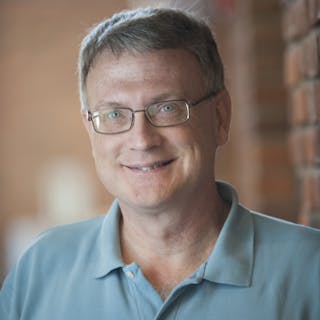
Brian Beecken
Professor of Physics and Engineering and Department Chair | beebri@bethel.edu | Started at Bethel: 1988
Dr. Beecken received his M.S. and Ph.D. in physics from the University of Minnesota and then spent 2 years on the engineering technical staff at Texas Instruments. One of his research interests is modeling the charging of dielectrics on spacecraft, and he has collaborated with both NASA's Jet Propulsion Laboratory (JPL) and the Air Force Research Lab in Boston and Albuquerque. Other research interests are optical detectors, including work on infrared detector limitations at Arnold Engineeri. . . read more.
Faculty

Peter Christenson
Adjunct Instructor of Physics and Engineering | peter-christenson@bethel.edu | Started at Bethel: 2022
Adjunct Instructor of Physics and Engineering

Thomas Greenlee
Professor of Physics Emeritus | gretom@bethel.edu | Started at Bethel: 1979
Dr. Greenlee received his bachelor's degree in Chemistry from Michigan Technological University and his M.S. and Ph.D. degrees in physics from the California Institute of Technology. His doctoral dissertation was in experimental atomic spectroscopy applied to the determination of the solar abundance of manganese. Since coming to Bethel, he has had grants from 3M for laser interferometry to measure roughness of surfaces and temperatures of gases. Dr. Greenlee was awarded two summer research . . . read more.
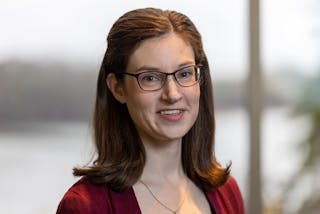
Alyssa Hamre Kontak
Assistant Professor of Physics | akh46956@bethel.edu | Started at Bethel: 2014
Prof. Hamre Kontak is passionate about teaching, including focusing on the exploration of new physics teaching methodology and doing some work in physics education research. Prior research focused on space plasma physics with a focus on the energy processes associated with the Northern Lights. She co-leads the Society for Physics Students group and she heads the Women in Physics & Engineering Club for the department.

Julie Hogan
Associate Professor of Physics | j-hogan@bethel.edu | Started at Bethel: 2017
Dr. Hogan is fascinated by fundamental particles, high energy phenomena, and the mysteries they can answer about the universe. She received her M.S. and Ph.D. in physics from Rice University. Since 2015, she has done postdoctoral research as a member of the Compact Muon Solenoid experiment, situated on the Large Hadron Collider at Conseil Europe;en pour la Recherche Nuclaire (CERN), or the European Council for Nuclear Research. Her primary interests are searching for new physics in jet-rich. . . read more.

Nathan Lemke
Adjunct Associate Professor of Physics and Engineering | lemnat@bethel.edu | Started at Bethel: 2018
Dr. Lemke received bachelors degrees in physics and applied physics from Bethel University and his Ph.D. in physics from the University of Colorado-Boulder. After postdocs at PTB (Germany) and the Argonne National Laboratory (Illinois), he was a staff scientist with the Air Force Research Laboratory in New Mexico. There he designed and developed a portable atomic clock as well as methods for laser time transfer. He has authored over 30 papers and holds provisional patents for his work with . . . read more.
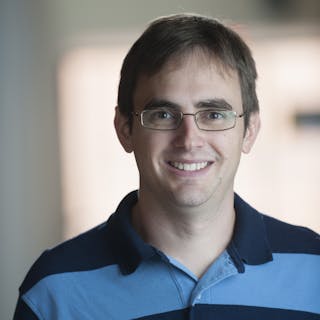
Nathan Lindquist
Professor of Physics | n-lindquist@bethel.edu | Started at Bethel: 2011
Dr. Lindquist received his M.S. in Physics and his Ph.D. in Electrical Engineering at the University of Minnesota. He teaches several upper-division courses in physics and engineering but also enjoys teaching general education courses for non-science majors. His research interests include sensors, imaging, nanotechnology, optics, microscopy, spectroscopy, holography, and plasmonics. In his labs at Bethel, students tinker with lasers, microscopes, cells, and molecules while pursuing interdis. . . read more.
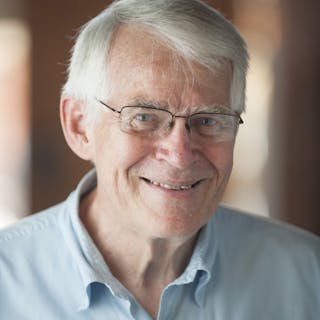
Richard Peterson
University Professor of Physics Emeritus | petric@bethel.edu | Started at Bethel: 1980
Dick Peterson received a Ph.D. in physics at Michigan State followed by a postdoctoral position in optical plasma diagnostics at Los Alamos National Laboratory. He has worked with Bethel students in developing new methods for fast optical measurements and received the American Physical Society's (APS) national prize for research at an undergraduate school and was elected a Fellow of the APS in 2005. He was elected to serve in 2003-2007 within the Presidential track of the American Associat. . . read more.
Wayne Raman-Nair
Professor of Physics and Engineering | w-nair@bethel.edu | Started at Bethel: 2023
Professor of Physics and Engineering

Keith Stein
Professor of Physics | k-stein@bethel.edu | Started at Bethel: 2001
Research interests include student-faculty studies utilizing advanced optical and high-speed video imaging techniques to study a number of applications involving compressible flows, shock waves, and thermal convection.
Jason Stroup
Adjunct Instructor of Physics and Engineering | jas43472@bethel.edu | Started at Bethel: 2022
Adjunct Instructor of Physics and Engineering
Daniel Upcraft
Adjunct Instructor of Physics and Engineering | d-upcraft@bethel.edu | Started at Bethel: 2023
Adjunct Instructor of Physics and Engineering